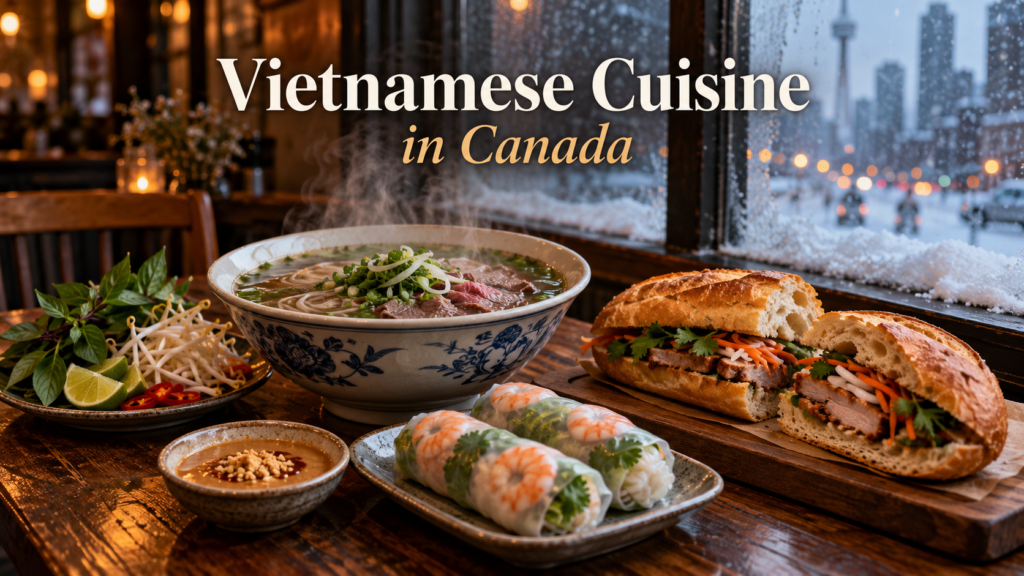
Quick answer: Vietnamese cuisine in Canada is concentrated in five metro areas: Toronto, Montreal, Vancouver, Calgary and Edmonton. Together they are home to most of the country’s roughly 275,000 people of Vietnamese origin (2021 Census). Pho is the dish most Canadians start with. In Quebec it’s often called soupe tonkinoise. Banh mi, fresh rolls, fried imperial rolls and bun bo hue are close behind. This guide shows where each city’s Vietnamese food is clustered and how Canadian menus name the dishes, so you can order with confidence anywhere from Scarborough to Surrey.
Vietnamese restaurants tend to follow the community. The 2021 Census counted 275,530 people of Vietnamese ethnic origin in Canada, about 0.76% of the population. Ontario has the largest share (122,735), followed by British Columbia (51,890), Quebec (45,570) and Alberta (39,395).
| Metro area | Vietnamese-origin population (2021) | Where to start looking |
|---|---|---|
| Greater Toronto | 82,225 | Chinatown around Spadina Ave & Dundas St W; North York, York, Scarborough, Etobicoke |
| Greater Montreal | 38,660 | Vietnamville near Jean-Talon metro; Côte-des-Neiges; Chinatown (Quartier chinois) |
| Greater Vancouver | 34,915 | East Vancouver, Richmond, Surrey |
| Calgary | 21,010 | International Avenue (17 Ave SE) |
| Edmonton | 14,180 | Chinatown |
| Ottawa–Gatineau | 9,650 | Chinatown |
| Winnipeg | 5,580 | — |
| Waterloo Region · Hamilton · London | 5,555 · 4,855 · 3,110 | — |
Source: 2021 Census figures as compiled in Vietnamese Canadians (Wikipedia). Neighbourhoods from the sources listed at the end.
What that means in practice: if you live in one of the top five metros, you can usually find several Vietnamese restaurants within a short drive. In smaller cities you’ll find fewer places, and they tend to be pho-focused, with longer menus that cover everything.
Canada’s Vietnamese restaurants grew out of the families who settled here, and the timeline explains a lot about the menus you see today.
Many of those families came from southern Vietnam, which is why southern-style dishes such as pho served with a plate of fresh herbs, broken-rice plates (com tam) and banh mi are so common in Canada. Central dishes like bun bo hue appear on many menus too.
The same dish can have three names in Canada: the Vietnamese name, an English description and, in Quebec, a French one. Here’s a cheat sheet.
| Vietnamese | English menus | Quebec French menus | What it is |
|---|---|---|---|
| Phở | Pho, beef noodle soup | Soupe tonkinoise, soupe pho, pho | Rice-noodle soup in a long-simmered beef (or chicken) broth |
| Bún bò Huế | Bun bo hue, spicy beef noodle soup | Bun bo Hue | Lemongrass-and-chili beef soup with thick round rice noodles |
| Bánh mì | Banh mi, Vietnamese sub (Toronto press has also called it a “Saigon sub”) | Sandwich banh mi | Airy baguette with pâté, cold cuts or grilled meat, pickles and herbs |
| Chả giò / nem rán | Imperial rolls, egg rolls, fried spring rolls | Rouleaux impériaux, nems | Fried rolls, traditionally rice paper filled with pork, vermicelli and black fungus |
| Gỏi cuốn | Fresh rolls, salad rolls, summer rolls | Rouleaux printaniers, rouleaux de printemps | Soft, unfried rice-paper rolls with herbs, vermicelli and shrimp or pork |
| Bún | Vermicelli bowl | Vermicelles, bol de vermicelles | Cold rice vermicelli with grilled meat, herbs and fish-sauce dressing |
| Cơm tấm | Broken rice plate | Riz (assiette) | Broken rice with grilled pork chop, often with egg meatloaf |
Quebec’s official language office (OQLF) lists soupe tonkinoise, soupe pho and pho as coexisting terms in Quebec. It also notes that in French the word pho is usually pronounced like feu. For a full French–English–Vietnamese breakdown, see our Quebec menu glossary.
Toronto has Canada’s largest Vietnamese community, and its food is spread across several hubs rather than one strip. The older cluster is in Chinatown around Spadina Avenue and Dundas Street West. Many families also settled in the inner suburbs of North York, York, Scarborough and Etobicoke, so some of the busiest pho and banh mi shops sit in suburban plazas, not downtown. Toronto also has a strong banh mi culture, and local food media regularly publish banh mi round-ups. → Vietnamese restaurants in Toronto
Montreal is where Vietnamese food in Canada sounds most different. Menus are usually in French first, so pho appears as soupe tonkinoise and fried rolls as rouleaux impériaux. Vietnamville, near Jean-Talon metro, is the city’s best-known cluster of Vietnamese businesses. Côte-des-Neiges is a long-standing pho destination for residents and students, and Chinatown, Saint-Michel and Rosemont all have places worth knowing. → Vietnamese restaurants in Montreal
Pho is popular throughout Vancouver. The community is spread between East Vancouver, Richmond and Surrey, so it’s worth checking which side of the Fraser River you’re on before you head out. The region’s large Asian supermarkets also make it one of the easier places in Canada to cook Vietnamese food at home. → Vietnamese restaurants in Vancouver
Calgary’s most concentrated stretch is International Avenue (17 Avenue SE) in the Forest Lawn area, home to a strip mall called Little Saigon Towne Square. → Vietnamese restaurants in Calgary
Edmonton’s Vietnamese noodle shops cluster in and around Chinatown, where local food writers regularly round up the best bowls for cold days. Expect pho, bun bo hue and hu tieu side by side on the same menu. → Vietnamese restaurants in Edmonton
Ottawa’s Chinatown has a cluster of Vietnamese restaurants, and the community extends across the river to Gatineau, where menus switch to French. Winnipeg, Kitchener-Waterloo, Hamilton, London and Windsor each have smaller communities. Start with our city pages and the near-me finder.
If you’re new to Vietnamese cuisine, these four dishes are on almost every Canadian menu:
Which Canadian city has the most Vietnamese people? Toronto. The Greater Toronto Area had 82,225 people of Vietnamese ethnic origin in the 2021 Census, more than Montreal (38,660) and Vancouver (34,915).
What is pho called in Quebec? Often soupe tonkinoise. Quebec’s language office lists soupe tonkinoise, soupe pho and pho as terms that coexist in Quebec, and many Montreal menus use more than one.
What’s the difference between imperial rolls and fresh rolls on Canadian menus? Imperial rolls (rouleaux impériaux, chả giò) are fried. Fresh rolls (rouleaux printaniers, gỏi cuốn) are soft and unfried, wrapped in rice paper with herbs and vermicelli.
Is Vietnamese food in Canada different from Vietnamese food in the US? The dishes are the same, but the context differs: Quebec menus use French names, Canadian menus and groceries are metric, and the biggest communities are in Toronto, Montreal and Vancouver rather than California and Texas.
Where can I buy Vietnamese ingredients in Canada? T&T Supermarket stores in BC, Alberta, Ontario and Quebec carry the basics, and independent Asian grocers in each city usually have more. We’re putting together a city-by-city ingredient guide.
